
Article: What's Really in Your Skincare? The Ingredients Worth a Second Look
What's Really in Your Skincare? The Ingredients Worth a Second Look
The beauty industry promises us younger, brighter, healthier skin. But how often do we stop to ask what's actually inside those beautiful little bottles?
We're living in the age of optimization. We're looksmaxxing. Proteinmaxxing. Sleepmaxxing. Tracking our steps, taking cold plunges, counting macros, scrutinizing nutrition labels, and spending small fortunes on organic produce. We've become amateur detectives when it comes to what we put into our bodies. But what about what we put on our skin!?
Think about it. We dutifully wash our faces, apply our serums, massage in our moisturizers, and layer on our latest miracle treatments, often without the faintest idea what they contain. We're seduced by gorgeous packaging, clever marketing, and promises of eternal youth. A cream that costs $200 must be extraordinary, right? Not necessarily.
Your skin is your body's largest organ, a remarkable living barrier that protects you from the outside world. And while it doesn't indiscriminately absorb everything you apply to it, certain substances can penetrate the skin depending on their molecular structure, concentration, and formulation. Which makes understanding the ingredients in your skincare more than just another to-do item — it's an essential part of becoming a conscious consumer.
And the good news? You don't need a chemistry degree to get started.
The First Five: Your New Skincare Rule

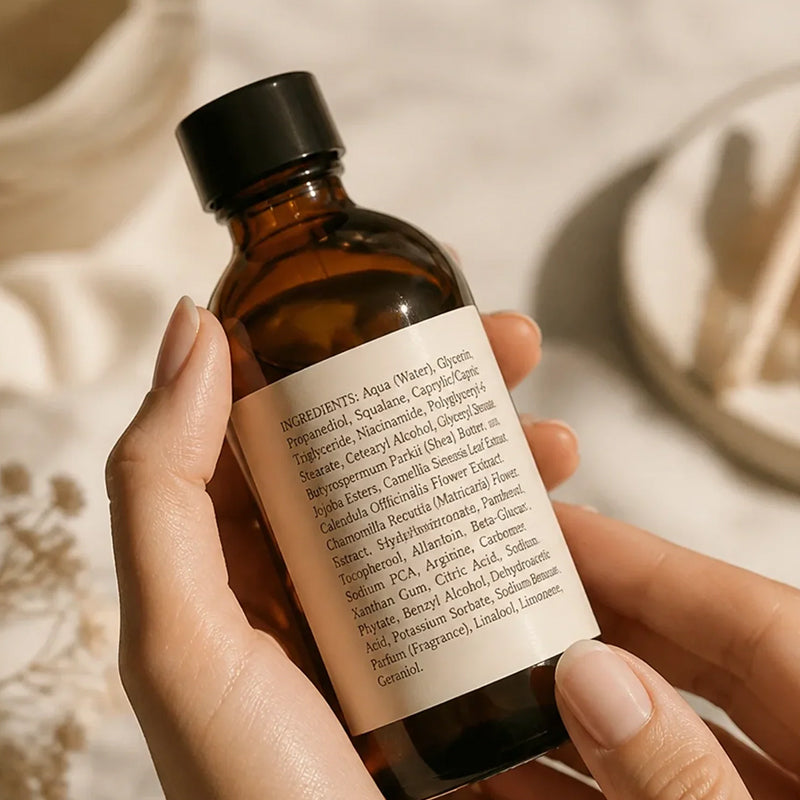
Here's one habit that could change the way you shop for skincare forever: READ THE FIRST FIVE INGREDIENTS. Not the seductive promises on the front of the bottle. Not the celebrity endorsements. Not the words clean, pure, natural, or dermatologist-approved splashed across the packaging. Turn the bottle around!
Cosmetic ingredients are generally listed in descending order of concentration by weight, with certain exceptions for ingredients present at 1% or less. That means the first five ingredients usually give you a pretty good idea of what makes up the bulk of a product.
Is your supposedly luxurious botanical moisturizer mostly water, inexpensive fillers, alcohol and fragrance? Is that miracle serum built around ingredients that actually support your skin, or is its star botanical extract buried near the bottom of a very long laundry list?
The first five won't tell you everything about a formula, but they're an excellent place to start. Consider them your skincare reality check. Simply ask yourself: Do I recognize them? Do I understand what they’re doing there? And are these ingredients I actually want on my face, absorbing into my dermis?
Let's clear something up about the terms clean and “all-natural” before we go any further.
Clean Beauty: Beyond the Marketing Hype
Natural doesn't automatically mean safe. Synthetic doesn't automatically mean harmful. And the word chemical isn't synonymous with toxic. Water is a chemical. Vitamin C is a chemical. So is hyaluronic acid, one of the beauty industry's most beloved ingredients. The real questions are: What is the ingredient? Where is it coming from? How is it produced? What purpose does it serve? How much of it is in the formula? And how does it interact with your skin?
At Jenette All Natural Skin Care, founder Jenette Serrins takes a deliberately selective approach to formulation, emphasizing top-quality botanical ingredients, careful sourcing, and a belief that what you leave out of a product can be just as important as what you put in. It's a philosophy that begins with knowing your ingredients — and being willing to question them. So let's take a closer look at some of the usual suspects lurking on skincare labels.

Ingredients to Think Twice About
This is where things get interesting. Rather than declaring every ingredient below “toxic,” it's more helpful to understand why certain ingredients have attracted scrutiny — and why we choose to avoid them.
Benzoyl Peroxide: The Acne Fighter With a Complicated Story
For decades, benzoyl peroxide has been a go-to ingredient for treating acne. It kills acne-causing bacteria and can be effective at clearing breakouts. But in 2025, this familiar bathroom-cabinet staple found itself making headlines for a very different reason.
The FDA tested 95 acne products containing benzoyl peroxide after concerns emerged about possible contamination with benzene, a known carcinogen. While more than 90% of the tested products contained undetectable or extremely low benzene levels, several products were voluntarily recalled because of elevated contamination.
The distinction matters: benzoyl peroxide itself wasn't banned. The concern was that it can degrade under certain conditions, particularly heat and prolonged storage, potentially forming benzene.
There are also reasons some people choose to avoid benzoyl peroxide even when contamination isn't an issue. It's a powerful oxidizing ingredient, and that power can come at a price. Dryness, redness, peeling, and irritation are common complaints.
For some skin types, especially those prone to discoloration, irritation can trigger post-inflammatory hyperpigmentation — the frustrating dark marks that sometimes linger long after a breakout has disappeared. That doesn't make benzoyl peroxide universally evil. However, it does make it worth understanding before you reach for it.
Alcohol: When Your Skin Pays the Price
You know that squeaky-clean, tight feeling after washing your face? The one that makes you think your cleanser has really done its job? Your skin may disagree, especially the longer you use. Certain alcohols, particularly ethanol or alcohol denat in high concentrations, can strip away healthy surface oils and disrupt the skin barrier. And when that barrier becomes compromised, dryness, irritation, and increased sensitivity can follow.
Your skin also hosts a complex ecosystem of microorganisms known as the skin microbiome. Maintaining a healthy barrier helps support that ecosystem, which is one reason overly aggressive skincare continuing alcohol can be counterproductive. Plus, your face shouldn't feel like it's been scrubbed with an industrial-strength detergent.
Glycols: The Ingredients You Probably Never Think About
Propylene glycol. Butylene glycol. Pentylene glycol. Polyethylene glycol. They sound like something from a chemistry exam, not your evening beauty ritual. Yet glycols and glycol-derived compounds appear in countless skincare products, where they can serve as humectants, solvents, texture enhancers, or ingredients that help a formula stay uniform.
Many have established safety profiles when used appropriately. Still, they're not interchangeable, and many can cause irritation or contact reactions in susceptible individuals.
Jenette deliberately avoids PEGs and glycols as part of her formulation philosophy, preferring other ways to create the texture and performance she wants, as well as healthier stabilizers that beautifully preserve her advanced, yet delicate formulas.
Preservatives: The Necessary Evil?
Here's an uncomfortable truth about skincare: a beautiful cream filled with botanical extracts can become a breeding ground for microorganisms if it isn't properly preserved. Water-containing products, in particular, need effective preservation systems to protect them from bacteria, yeast, and mold. So yes, preservatives are necessary in many formulations. But that doesn't mean every preservative is equally desirable for every person.
Some preservatives are known to trigger allergic reactions in susceptible individuals. Among those worth recognizing are formaldehyde-releasing preservatives, including DMDM hydantoin, quaternium-15, imidazolidinyl urea, and diazolidinyl urea.
These ingredients can release small amounts of formaldehyde over time. Their presence doesn't automatically make a finished product unsafe, but they may be particularly relevant for consumers with allergies or sensitive reactive skin.
Cost is another part of the formulation equation for some brands. Like any manufacturer, skincare companies must balance ingredient prices, performance, stability, and profitability. Less expensive ingredients aren't necessarily always inferior, but neither should attempts to save costs come at the expense of safety risks.
The question isn't whether your skincare contains preservatives. It's whether the preservation system is effective, suitable for the formula, and compatible with your skin. Jenette uses a fermented, probiotic-derived ingredient as a natural stabilizer and preservative. Leucidal® Liquid PT, derived from the fermentation of radish root using Lactobacillus bacteria.
It stabilizes her formulations naturally, helping to prevent microbial contamination and boosts the immune system of the dermis. It also provides antimicrobial activity, protecting the product from unwanted microorganisms.
Fragrance: The Beautiful Mystery
Few things are more seductive than a luxurious skincare fragrance. A hint of rose. A whisper of bergamot. Something reminiscent of a very expensive spa or elegant evening out. But the word fragrance on an ingredient list can conceal a surprisingly complicated blend of substances.
Under U.S. cosmetic labeling rules, fragrance mixtures can generally be listed under the collective terms fragrance or parfum, without individually disclosing every component. For people with sensitive or allergy-prone skin, this can make it difficult to identify potential triggers.
And here's another little beauty-industry twist: unscented doesn't necessarily mean fragrance-free. Some products contain masking fragrances designed to neutralize the smell of other ingredients. The important thing is knowing what your skin tolerates—and remembering that a lovely scent doesn't guarantee a lovely result.
Rather than using synthetic fragrances, Jenette scents only come from the mastered yet gentle use of essential oils and extracts, like precious floral absolutes, creating a natural, aromatherapeutic experience. Think rose absolute, rose geranium, tuberose, grapefruit, black pepper, basil, and others.
One thing all of her clients agree on? Her products smell amazing, delivering uplifting, grounding, calming and energizing sensations. Each one of her products takes you on a sensory journey.
Phthalates: What's Behind the Fragrance?

Phthalates are a family of compounds used for various purposes, including helping stabilize certain formulations. They've attracted attention because some members of the family have been associated with endocrine and reproductive concerns.
But not all phthalates behave the same way. Their safety profiles differ, and regulators assess them according to their specific use and exposure levels. For example, the FDA has stated that it does not currently have safety concerns about diethyl phthalate as used in cosmetics and fragrances. Still, consumers who prefer to minimize exposure may choose products with greater transparency.
At Jenette Skin Care, we never use phthalates because of concerns about their potential effects on human health, particularly the endocrine system.
SLS and SLES: When Clean Becomes Too Clean
We love a good lather. There's something incredibly satisfying about a cleanser that foams dramatically, as though all that bubbling proves it's working harder. But more foam doesn't necessarily mean cleaner, healthier skin. Sodium lauryl sulfate (SLS) and sodium laureth sulfate (SLES) are surfactants used to help lift oil, dirt, and impurities from the skin.
They're effective cleansing agents, but they tend to be drying or irritating, particularly for people with sensitive or compromised skin barriers.
A cleanser should leave your face feeling comfortable—not as though it's suddenly two sizes too small. If you're experiencing tightness, flaking, or persistent dryness after cleansing, your skin may be telling you that your routine is too aggressive. Listen to it. Or better yet: Simply do sans the SLS and SLES.
Retinoids, Hydroquinone, and the Problem with More, More, More
The beauty industry loves a powerful active ingredient. If one treatment works, surely three must work better? Not necessarily. Retinoids such as tretinoin are well-established treatments for acne and signs of photoaging. Hydroquinone can be effective for certain pigmentation concerns. And corticosteroids can help control inflammation in specific medical situations. Each has legitimate uses.
But combining powerful ingredients requires careful formulation and appropriate guidance.
Consider Tri-Luma, an increasingly popular prescription treatment for melasma that combines three active ingredients:
-
Tretinoin, a retinoid that promotes skin-cell turnover.
-
Hydroquinone, which reduces melanin production to address pigmentation.
-
Fluocinolone acetonide, a corticosteroid that helps control inflammation.
The combination is intended for short-term treatment of certain forms of melasma, not as an all-purpose brightening cream.
Hydroquinone, in particular, deserves careful use. Improper or prolonged use can contribute to irritation and, in rare cases, ochronosis—a difficult-to-treat form of skin discoloration. Claims that ordinary topical hydroquinone use causes liver damage are not yet established by clinical evidence.
This isn't an argument against dermatology or prescription skincare. It's a reminder that powerful ingredients have specific purposes, and more aggressive treatment isn't always better treatment. Your face is not a chemistry experiment.
Mineral Oil and Silicones: Are They Really the Villains?
Few skincare ingredients have suffered more from guilt by association than mineral oil. Yes, cosmetic-grade mineral oil is derived from petroleum. Highly refined mineral oil has a long history of cosmetic use and can be an effective ingredient for reducing moisture loss. Similarly, silicones such as dimethicone are widely used to improve texture, protect the skin barrier, and create a smooth finish. But do you really want to slather a cream made with crude petroleum on your face?
Jenette's preference for botanical oils represents a different formulation philosophy. She avoids petroleum-derived mineral oil in favor of nutrient-rich cold-pressed oils that not only help lock in moisture but also deliver beneficial fatty acids, antioxidants, and other naturally occurring compounds.
Think cold-pressed rosehip seed oil, packed with essential fatty acids and antioxidants; organic jojoba oil to soften skin and support its moisture barrier; organic sunflower seed oil to help retain moisture; and lightweight, cold-pressed grapeseed oil, to mention a few.
Plastic: The Problem Beyond the Bottle
We've become accustomed to plastic being everywhere. Our food arrives wrapped in it. Our water comes bottled in it. Our bathroom shelves are crowded with it. And increasingly, scientists are investigating what that ubiquity might mean for human health.
Microplastics have been detected in the environment, food, drinking water, and human biological samples. Researchers are still working to understand the consequences of different types and levels of exposure. You may have encountered the alarming claim that we ingest a credit card's worth of plastic every week. Plastic pollution is a significant environmental concern, and reducing unnecessary plastic use is a reasonable goal. For Jenette, that commitment extends beyond the finished packaging.
At Jenette All Natural Skin Care, ingredients never come into contact with plastic during preparation or production. Instead, Jenette relies on glass, including dark amber glass vessels in which her botanical preparations undergo an extended fermentation process.
It's an unusually uncompromising approach, and one that reflects her conviction that ingredient integrity involves more than simply checking a list of what's inside the finished product.
The Jenette Approach: Careful Crafting
In an industry obsessed with speed, novelty, and the next revolutionary breakthrough, Jenette is doing something decidedly different. At Jenette All Natural Skin Care, the philosophy begins long before a product reaches your face. Jenette emphasizes carefully selected botanical ingredients, seed-derived oils, and cold-pressed extraction methods designed to minimize unnecessary processing. And she has a firm rule: Seeds, never nuts. Jenette excludes nut-derived oils from her formulations because of her concerns about the allergies, inflammation and the potential for mold associated with certain nuts, along with their storage conditions.

Cold-pressed oils are another cornerstone. Unlike oils produced using certain high-heat extraction methods, cold-pressed oils are mechanically extracted with an emphasis on limiting heat exposure. Depending on the oil and processing conditions, this can help preserve some naturally occurring compounds. Jenette favors oils that haven't been subjected to unnecessary processing or alteration, choosing ingredients she believes retain more of their original botanical character.
And then there's the glass. No plastic. Ever.
From preparation through production, Jenette's ingredients are always stored in cool, protected environments. Her botanical preparations ferment for approximately 1-2 months in dark amber glass vessels before being incorporated into finished products. The amber glass helps shield light-sensitive ingredients, while the extended fermentation period reflects a philosophy that values patience and careful preparation over speed.
Fermentation is a distinct biological process, and its effects depend on the ingredients, microorganisms, and conditions involved. It doesn't automatically make a skincare product safer or more effective. But it is a defining feature of Jenette's approach to creating her botanical formulations. She also emphasizes small-batch production, carefully sourced ingredients, and organic botanicals whenever possible.
It's not simply about making something that smells beautiful or feels luxurious, although those pleasures certainly matter. It's about creating skincare with intention. And in a marketplace overflowing with products promising to transform your face overnight, there's something refreshing about a philosophy that doesn't revolve around instant gratification.
Your Skin Doesn't Need Another Miracle. It Needs Your Attention.
Here's the thing about the modern beauty industry: it's extraordinarily good at making us feel as though we're one product away from perfection. One more serum. One more acid. One more revolutionary ingredient with a name we can't pronounce. But healthy skin isn't necessarily the result of the most complicated routine, the most expensive cream, or the longest ingredient list.
Question marketing claims. Understand the difference between an ingredient's reputation and what the science actually says. And above all, become curious about what you're putting on your face.
Sometimes, the smartest thing you can do is simplify.
Jenette consistently tells her private clients: “It’s not that you need 20 skincare products to have healthy skin. But please be consistent with six really good ones: Cleanser, toner, focused vitamin serum, appropriate mask, moisturizer, and reef safe sunscreen!”
Know what's in your skincare. Know why it's there. And don't let a beautiful bottle do all the talking.
Your skin deserves at least as much attention as your morning smoothie.
→ Explore Jenette's All Natural Skin Care Collection or make an appointment to discuss your skin needs and concerns at our beautiful spa and boutique, Being in LA.


Leave a comment
This site is protected by hCaptcha and the hCaptcha Privacy Policy and Terms of Service apply.